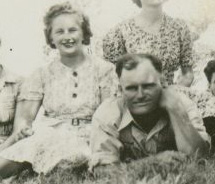
Irene & Buddy Johnson
The Truth About What Is Happening to Our Grandmother, Irene, in Montgomery County, Iowa
the truth:
This website's purpose is to document the absolute nightmare our family has experienced since the death of our grandfather, Milton Johnson, Jr., in April 2001. This site is also meant to document the nightmare being experienced by our elderly grandmother, who has been isolated from our family and subjected to psychological abuse for the last two years, since her husband's death. She is 82 years old, and is very frail after nearly a decade of dialysis. She lives in a rural, farming area.
There have been repeated obstructions of justice during our extensive efforts to see her, get her removed from her "captors," and to hold responsible those who are involved in this con-game. Due to the size of her estate, much is at stake for those who do not want her family to see her or spend time with her. It is almost unbelievable the extent to which they have gone to to try to keep her apart from us.
This website is intended to describe what has happened during the last two years and what continues to happen, despite all of our efforts to intervene and seek help for her. It is also intended to correct the myths and gossip being put forth by those who do not want the truth to see daylight.
Psychological abuse in the elderly is very real, and especially vulnerable are older widows whose husbands took care of all of their financial and business matters. Even more vulnerable are elderly women who are very physically frail and weak and who depend upon caregivers while they are still living at home. This is the case with our grandmother, and in her weakened state, she is being preyed upon by those who pretend to be her "friends" and "caregiver."
According to national statistics on elder abuse, the vast majority of elder abuse is committed not in nursing homes, but rather by self-designated "caregivers" and adult children living at home with the elderly person. What happens in psychological abuse is that the elderly person will be isolated from her family, which includes censoring the mail, controlling phone calls, blocking visits from family and friends, and even locking the elderly person in her home. All of these things have repeatedly happened to our grandmother over the past two years.
Next, the psychological abuse entails fostering a fear of family members, by telling the elderly person that she will be put in a nursing home or lose all her money and that only the self-designated "caregivers" (i.e., con-artists) will protect her from these fictitious, falsified threats. This is known as the siege mentality, and this, too, has repeatedly occurred in our grandmother's case.
Next, after cutting the person off from all contact with family, the abusers will foster a sense of dependency, as if they are the only persons who care about the elderly person. This deception is based on psychological manipulation and isolation, and is what is known as the "Stockholm Syndrome," whereby the captor forms an emotional bond with her victim and exploits a sense of dependency, especially when the victim is physically frail. These are the same symptoms which have been documented by psychologists such as Margaret Singer, an expert in the field of elder abuse.
These cases are even more of a nightmare when local officials refuse to do anything, file false representations with state officials, violate investigation procedures and fail to follow through on their obligations to protect the elderly in such instances. In this case, local officials have allowed those in power, who have a financial stake in this matter, to intervene and obstruct justice and distort the truth of what has been happening, and they have done so to the jeopardy of our grandmother's welfare and our relationships with her.
Indeed, because of this financial stake, local officials have assisted in retaliating against our family when we have tried to make people aware of what has been going on. It is extremely doubtful this abuse case would have been handled this way in a city or urban area, away from rural/county politics. They have repeatedly tried to censor the truth and distort the case, and thus this website comes into existence.
We appreciate your concern and interest. We have extensive documentation of what has occurred. Supporting documents and information from the past two years will be continuously added, as time permits. Please keep her in your prayers!
update:
On June 8th, 2004, our grandmother, Irene Johnson, passed away after ten years of dialysis treatments. The saddest part about her passing is that for the past three years — since our grandfather's death in '01 — she had been deliberately and wrongly isolated away from her family and friends and psychologically manipulated/abused. This website was first created in 2002 so as to tell the story of what has been happening to her and to our family since our grandfather's passing. It was also created to serve as a resource for information about elder abuse, particularly psychological abuse.
During those three years, we tried repeatedly to get help for our grandmother from various local and state agencies. We have extensive documentation of all of our attempts. The major problem, however, has been that the people involved in the elder abuse/scam had taken her to the law firm of the County Attorney in a small town to get her Will changed and that firm hopes to profit very handsomely from this situation of elder abuse. In fact, that law firm has already profited substantially from this situation over the past three years, and they hope to profit far beyond that. From 2001 through 2003, they made at least $50,000 from this case of elder abuse, and they undoubtedly made much more during 2004.
Indeed, that firm has actively participated in the isolation of our grandmother from our family, so they are equally complicit and culpable. We have significant evidence of them telling our grandmother that she was not allowed to see her family. They have used their leverage and power with local officials in a bogus attempt to retaliate against us and to demonize our family members, and there have been numerous obstructions of justice during our extensive efforts to get her assistance and to reunite with her.
These obstructions have included violations of investigative procedures by a local DHS employee, lies to cover-up those violations, giving verifiably false information to state authorities so as to discourage and prevent the state DHS and other authorities from investigating on their own, using the Sheriff's department to retaliate against us through filing falsified and unsubstantiated temporary injunctions and a trespassing charge in an effort to keep us away from our grandmother (we are a family of professionals with NO history of criminal problems whatsoever), and again repeatedly lying to state officials about our grandmother's case. We have extensive, written evidence to back up all of these allegations.
In the case of the trespassing charge, after our grandmother had already testified that the same visit with her adult granddaughter was "nice and pleasant" (and not trespassing at all) both the tape of that official hearing and the duplicate tape were found to have been mysteriously erased while held as evidence in the county courthouse after the hearing several months later. Someone did not want those tapes to exist, as they were proof that the charge had been falsified. The charge had been cooked-up so as to retaliate for an ethics complaint and a letter in the local newspaper. There had been no grounds for it in the first place, and it had not even been filed until four days after her granddaughter had visited and after our grandmother had been taken to the law firm of the County Attorney.
Keep in mind, the granddaughter happens to be a university professor. The trespassing charge was clearly retaliatory on the part of this law firm after her granddaughter had found her locked in her house all alone one day — they did not want us to visit her at all, let alone discover her in that condition. And it was also retaliatory since the charge occurred very soon after the granddaughter had filed an ethics complaint against this lawyer and had published a letter in the local newspaper about local authorities' indifference to elder abuse in this instance.
The local authorities could have cared the less about whether our grandmother was being locked in her home for hours on end, trapped in her chair with no assistance and sitting there alone in the dark without dinner or supper. And we now have evidence of another case in which the County Attorney's private law firm threatened another person with trespassing for visiting other elderly people in the area. This action, too, was designed to isolate the elderly people from their friends, and served the financial benefit of the law firm.
And when the adult grandsons tried to visit and found her locked in her home with no assistance, they tried to call the Sheriff's Department. When the deputy arrived, and they broke through the door, our grandmother told the deputy that she had been told that she was not allowed to have any visitors. This is on videotape. She clearly says on the tape, "I wasn't supposed to have anybody around here," and she also says, "He (her son) didn't want nobody to come here today at all." So, the deputy ordered her grandsons out of the house on those grounds that she had been told that she was not allowed to have any visitors, would you believe! The deputy did not care the less that she had been locked in the house with no way to get up from her chair. Again, this is all on videotape.
However, when the deputy wrote up his report, he excluded many of the details on the videotape, and then the copy of the report that our family acquired, was marked with a hand-written notation that it had been read and approved by the brother (a lawyer with the firm) of the County Attorney. This attorney had no business revising or approving Sheriff's reports, and yet his handwritten notations were on the report. So, this clearly evinced the fact that the Sheriff's Department was operating on behalf of the law firm. The deputy should have been concerned when she said that she was not allowed any visitors, as that is one of the signs of abuse.
As for the local DHS, we have written evidence that a local employee lied repeatedly to the State DHS and to other state authorities, giving them false information about the outcome of a hearing, lying in detail about a judge's decision-making and lying about our grandmother's physical condition and health. These lies were told so as to prevent state officials from doing their own investigations, per our requests. This DHS employee also violated investigative procedures by allowing the alleged abuser to be present at the table while she was interviewing our grandmother. Then she lied about his presence, claiming that he had been kept out in the yard. However, her written report represented him sitting at the table while she interviewed our grandmother, which is a direct violation of investigative procedures.
Not to mention, it goes against basic common sense to have the alleged perpetrator of the abuse present when interviewing the victim in an abuse investigation. It is difficult to imagine why an investigator would ignore what is essentially a cardinal rule in abuse investigations. Then this DHS employee refused to give us a copy of the report, citing confidentiality rules, so she assumed that our family would never see her written report due to those rules. Those kinds of confidentiality rules actually protect DHS employees from accountability in these kinds of cases. When we finally acquired a copy of the report, that is when we discovered that this local DHS employee had seriously lied to us.
To note, a witness observed this lawyer visiting the local DHS office during the same period when the State DHS was being aggressively discouraged by this local employee from sending in their own investigator. Moreover, when family members would try to visit our grandmother at the hospital where she was being treated for dialysis, this lawyer from the county attorney's law firm would actually call up the hospital (located in a different County) and try to tell them not to let her family see her. We have a letter from hospital officials documenting these efforts on the part of this attorney. The hospital told him that they would only honor Irene's wishes, and that he should stop calling.
When these efforts failed, he began ordering our grandmother not to see her family at the hospital, and he would use this transient/neighbor woman to report back to him whenever family visited the hospital. We have our grandmother on tape saying that she was told by this attorney that she was not allowed to see any of her family. She said that he told her that she could not talk to any of her family members. She clearly expressed fear of him. Again, we have this on tape. This was nothing less than psychological abuse on the part of this attorney.
In another instance when our grandmother was hospitalized in Omaha with a dire, life-threatening condition at the end of 2002, they (i.e., those responsible for the abuse) tried to hide our grandmother from us at the hospital. First, they did not tell us that she was hospitalized. Then, after we found out and rushed to the hospital and after her granddaughter and other family members had had a warm and friendly visit with her during her first day at the hospital, they (again, those responsible for the abuse) moved her to a different hospital room in an attempt to hide her from the entire family. They actually tried to tell hospital officials not to tell the entire family where her room was located at. Once again, this attorney was involved in these efforts to hide our grandmother from us when she was very sick and ill.
Then after we discovered the room to which they had moved her, they repeatedly lied to nursing staff in a bogus, futile effort to try to keep us from seeing her. We have hospital documentation of these efforts. Then, immediately after this hospital stay, they changed her to a different dialysis doctor in an effort to keep us from knowing the next time she was hospitalized. This doctor had been working with our grandmother for eight years, and they switched her to a different doctor and a different hospital for the sole purpose of trying to keep her away from us.
the story, from the beginning:
Soon after grandfather's passing, an adult son who had lived in their basement for most of his life and a transient/neighbor woman who had volunteered to transport Irene to her dialysis treatments, began isolating Irene from her entire family. When family members would show up to take her to dialysis themselves, this son would yell at them and tell them to go away. Only two days after our grandfather's funeral, our grandmother was taken to an attorney so that this son would have power of attorney over her. Then they began secretly taking her to a series of attorneys, as we discovered after the fact.
We have evidence that this woman was researching and dictating the attorneys to which they were taking her, and this woman would sit in the attorneys' offices with our grandmother when she had no business meddling in our grandparents' business. Our grandfather would have been appalled to have known that his private business matters were being shared with this transient con-artist! Our grandfather had handled all the business and legal affairs for our grandmother, and our grandmother had never been to an attorney by herself during her entire life.
This woman and the son would lie to our grandmother about how she was going to be put in a nursing home by the rest of the family. The family had no intentions of ever putting her in a nursing home. In fact, we had tried to hire a professional caretaker to assist our grandmother, yet the son had fired that person because he did not want anyone in the home. However, they used this false fear of being put in a nursing home as a way to try to scare our grandmother.
This website will be next updated towards the end of April, when time permits. The story is very, very long at this stage. This has been a three-year nightmare for our family.